
A Routine ECG, Read for Coronary Disease
HEARTio is developing AI software designed to estimate the presence and extent of coronary artery disease (which vessel, how narrowed, and the likely effect on blood flow) from the 10-second, 12-lead ECG clinics already record. It is investigational and not available for clinical use.
Published in JACC: Advances·Canadian Journal of Cardiology·Circulation·JACC












Someone in the U.S. has a heart attack every 40 seconds.
Coronary heart disease is the most common type of heart disease. Plaque builds in the arteries of the heart for years without symptoms, and today it is usually found only after a patient has symptoms, or after the attack itself.
Finding it earlier means an invasive catheterization, a CT with contrast or a nuclear perfusion scan. Each needs a referral, a specialist and a machine the patient has to travel to.
Source: CDC, Heart Disease Facts
Coronary artery: plaque narrows the vessel long before it blocks it.
HEARTio is being built for the step before those tests: an aid intended to help providers decide earlier who to refer for diagnostic testing. It is not a substitute for that testing.
Record, Read, Review
No new hardware, no contrast and no radiation. The input is the resting ECG a clinic already takes.
-
1
Record
A standard 10-second, 12-lead resting ECG, in the format the machine exports, or a photo of the paper print-out.
-
2
Read
AI developed on ECGs paired with angiography and PET-CT reference data. It runs on an ordinary CPU, so it fits a clinic, a cart or the cloud, and it returns in seconds.
-
3
Review
A PDF report, a browser console and an iPhone app, each showing the ECG it read, every call with its confidence and every measurement with its spread, and a plain-language summary.
One Read, Three Surfaces
The same estimates, in the same words and colors, on paper, in the browser and on the phone. HEARTio is intended as an aid to support referral for diagnostic testing such as angiography, not to replace it, and it has not been cleared or approved by the U.S. FDA.

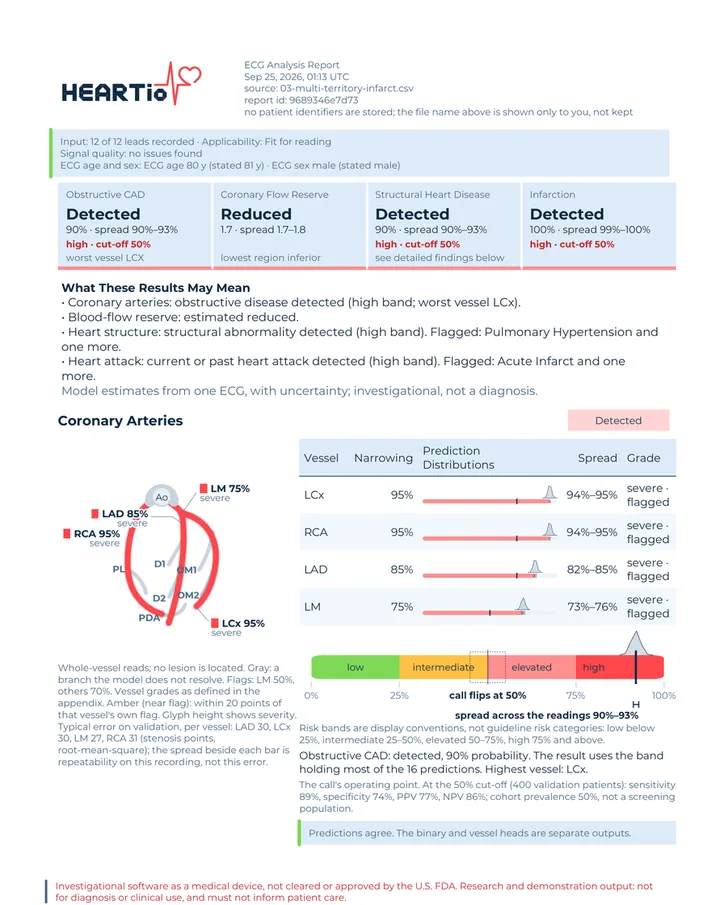
- ReportA PDF for the record, with the recording the model read and the investigational disclaimer.
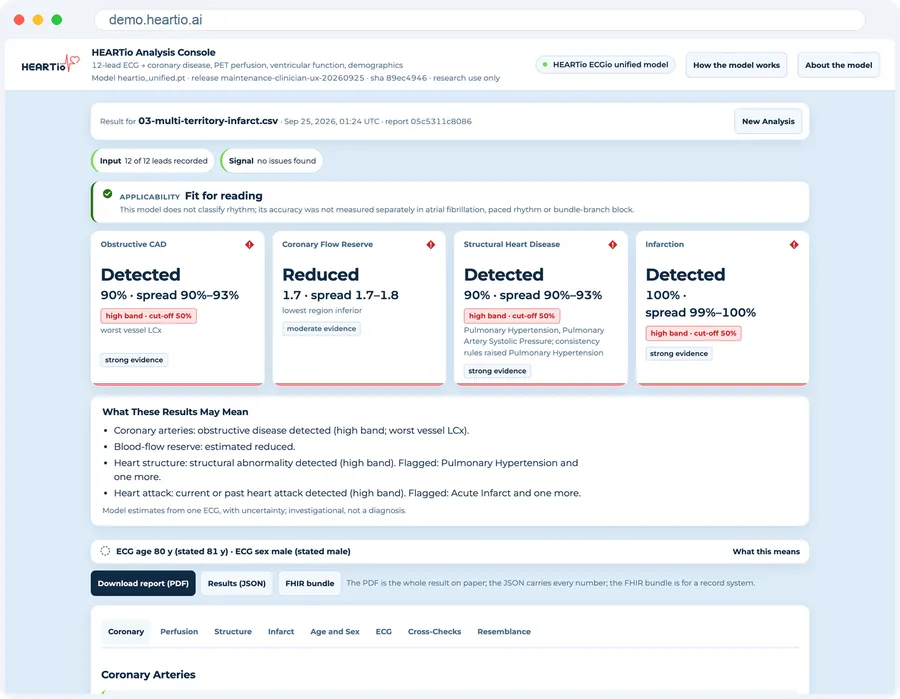
- ConsoleEvery card opens with the call in words (Estimated present, Estimated not present, Borderline or Undetermined). A yes-or-no call carries its confidence; a measurement keeps its value and spread.
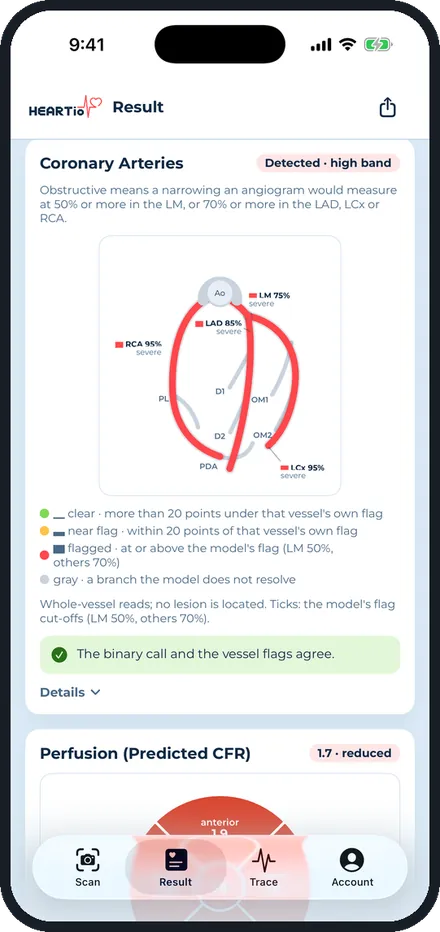
- iPhoneThe LM, LAD, LCx and RCA on an angiographer's tree, colored by estimated narrowing; branches the model does not resolve are gray.
One ECG, Many Estimates, Each at Its Own Stage
The same 10-second recording carries every output below. Each is moving through clinical evidence on its own track, and all of them are investigational.
| Output | 1Internal Validation | 2External Validation | 3Pivotal Study | 4FDA Submission |
|---|---|---|---|---|
| Obstructive Coronary Artery DiseaseFDA Breakthrough Device DesignationThe obstructive CAD call, and estimated narrowing in the LM, LAD, LCx and RCA.Pivotal Study | Completed | Completed | Current stage | Not yet |
| Coronary Flow Reserve (PET-CT)Predicted flow reserve for the whole heart and four myocardial territories, developed against PET-CT.External Validation | Completed | Current stage | Not yet | Not yet |
| 15-Lead ReconstructionMissing leads reconstructed from the ones recorded, including the three Frank leads.External Validation | Completed | Current stage | Not yet | Not yet |
| Structural Heart DiseaseLV hypertrophy, pulmonary hypertension, valve regurgitation, aortic stenosis, RV dysfunction and pericardial effusion.Internal Validation | Current stage | Not yet | Not yet | Not yet |
| LV Function and Echo MeasuresEstimated ejection fraction, wall thickness, pulmonary artery pressure and peak TR velocity.Internal Validation | Current stage | Not yet | Not yet | Not yet |
| Myocardial InfarctionAny infarct pattern, old and acute, and the anteroseptal and inferior territories.Internal Validation | Current stage | Not yet | Not yet | Not yet |
FDA Breakthrough Device designation is not a clearance or approval. Every HEARTio output, including coronary artery disease, is investigational and has not been cleared or approved by the U.S. FDA.
Published and Presented
Work by the HEARTio team and its clinical collaborators, from lead reconstruction to angiography- and PET-CT-verified estimates of coronary disease.
- JACC Advances2026Use of Electrocardiograms to Identify Coronary Artery DiseaseLeasure M, Poornima I, Butchy A, et al. JACC: Advances. 2026;5(3):102573.doi:10.1016/j.jacadv.2025.102573View paper
- JACC TCT2025TCT-898 A PET-CT verified AI Algorithm to predict the ischemic impact of Coronary Artery DiseaseLeasure M, Mintz G, Covalesky V, Jain U, Butchy A. JACC. 2025;86(17):B386-B387.doi:10.1016/j.jacc.2025.09.1081View paper
- Can J Cardiol2021Deep Learning Algorithm Predicts Angiographic Coronary Artery Disease in Stable Patients Using Only a Standard 12-Lead ElectrocardiogramLeasure M, Jain U, Butchy A, et al. Canadian Journal of Cardiology. 2021;37(11):1715-1724.doi:10.1016/j.cjca.2021.08.005View paper
- 2024medRxivView paperArtificial Intelligence Analysis of ECG to Determine Fractional Flow Reserve (FFR)Kalińczuk Ł, Zieliński K, Sadowski KA, Leasure M, Butchy A, Jain U, Covalesky VA, Wolny R, Demkow M, Opolski M, Mintz GS. Published online August 28, 2024.doi:10.1101/2024.08.27.24312672
- 2023BiomedicinesView paperImportance of Electrode Selection and Number in Reconstructing Standard Twelve Lead ElectrocardiogramsButchy AA, Jain U, Leasure MT, Covalesky VA, Mintz GS. Biomedicines. 2023;11(6):1526.doi:10.3390/biomedicines11061526
- 2023IEEE BIBMView paperClassification of Abnormal Cardiac Rhythm from Brief Single-Lead ECG Recordings using Embeddings from Transformer Encoder ModelsJain U, Menon PG. 2023 IEEE International Conference on Bioinformatics and Biomedicine (BIBM). 2023:4899-4901.doi:10.1109/bibm58861.2023.10385454
- 2023CirculationView paperAbstract 18317: Implications of Noise on Deep Learning Models for 12-Lead ECG ConstructionJain U, Leasure M, Butchy A, Covalesky VA, Mintz GS. Circulation. 2023;148(Suppl 1).doi:10.1161/circ.148.suppl_1.18317
- 2023BIOSTECView paperRedundancy and Novelty Between ECG Leads Based on Linear CorrelationJain U, Butchy A, Leasure M, Covalesky V, McCormick D, Mintz G. Proceedings of the 16th International Joint Conference on Biomedical Engineering Systems and Technologies. 2023:359-365.doi:10.5220/0011815700003414
- 2022BIOSIGNALSView paper12-Lead ECG Reconstruction via Combinatoric Inclusion of Fewer Standard ECG Leads with Implications for Lead Information and SignificanceJain U, Butchy A, Leasure M, Covalesky V, McCormick D, Mintz G. Proceedings of the 15th International Joint Conference on Biomedical Engineering Systems and Technologies. 2022:133-141.doi:10.5220/0010788600003123
- 2021CirculationView paperAbstract 13330: Deep Learning Algorithm Predicts Angiographic Diameter Stenosis in Stable Patients Using Only a Standard 12-lead ElectrocardiogramLeasure M, Jain U, Covalesky VA, McCormick DJ, Mintz GS. Circulation. 2021;144(Suppl 1).doi:10.1161/circ.144.suppl_1.13330
- 2021JACC · TCTView paperTCT-60 Deep-Learning Algorithm Predicts Presence of Angiographic Coronary Artery Disease in Stable Patients Using Only a Standard 12-Lead ElectrocardiogramJain U, Leasure M, Butchy A, Covalesky V, McCormick D, Mintz G. Journal of the American College of Cardiology. 2021;78(19):B24-B25.doi:10.1016/j.jacc.2021.09.910
Watch
An overview of HEARTio, then talks and pitches from the team. Each recording reflects the date it was made.
Engineers, Cardiologists and Operators, Together
A founding team out of the University of Pittsburgh and the Wharton School, backed by advisors across interventional and nuclear cardiology, emergency medicine, regulatory affairs and capital markets.
Executive Team
Email any of us to learn more.


Board Observers

Advisors
Clinical Advisory
Interventional, nuclear and structural cardiology, cardiothoracic surgery, critical care and emergency medicine.


Product Development Board
ECG interpretation, medical AI and clinical strategy.


Business & Strategy
Medtech operators, product leaders and global strategy.


Regulatory & Reimbursement
FDA, quality systems, biostatistics and reimbursement.


Capital Raising & Financial
Fundraising, transactions and financial strategy.


Backed by Health Systems, Funds and Programs
The health systems that share the data, the funds that back the company, and the programs that shaped it. HEARTio has completed its pre-seed and seed rounds.
Investors
Clinical Partners


Incubators & Accelerators





Awards & Honors
- Forbes 30 Under 302024 Honoree
- Pittsburgh Business Times 30 Under 302022 Honoree
- PDMAInnovator of the Year
- ISMICSInnovators of the Year
- LIFTOFF PGHFirst Place
- Baylor New Venture CompetitionFirst Place
- Tulane Business Model CompetitionFirst Place
- University of PittsburghInnovators of the Year
Work With HEARTio
We work with health systems and research groups, investors and press. Every message reaches the founding team.
- Clinical and Research PartnersSites with ECGs and angiography or PET-CT who want to evaluate the software with us.
- InvestorsThe team, the data and the regulatory path, in conversation.
- PressInterviews, images and the story behind the company.
HEARTio Analysis Console
The console is available to partners and investors for research and demonstration purposes only. It is not for clinical use and must not inform patient care. Drop in an ECG file, or pick a sample record, and see the model's estimates.
Upload a resting ECG in the format your machine exports. The console reads it and returns thirty-six outputs — coronary, perfusion, structural, infarct, function and the 15-lead reconstruction — each with its 16-reading distribution, plus a downloadable sixteen-page report (a typical length) with all cohort/model performance consolidated at the end. Detailed input warnings can add pages.
Sign-in required. Research use only.
- Any ECG, any format12-lead or fewer, any sampling rate. Even a single-lead watch strip is handled, with the caveat shown.
- Or a photo of the paperNo digital export? Photograph or scan the print-out. Each trace is read off the grid and digitized. The leads it recovered are shown, and a doubtful read stops for review before anything is analyzed.
- See the ECG the model readThe recording is shown lead by lead beside the estimates, so nothing is a black box to the reviewer.
- Coronary tree and flow mapPer-vessel stenosis on an angiographer's coronary tree, and predicted flow reserve across the four myocardial territories.
- Report and JSON exportA PDF summary for review and a structured document for research integration.